
In the Search for Sulfite-Free Wines
By Dimitri Nicolaides, Agronomist Engineer, M.Sc. in Oenology.
In recent years, we have witnessed a growing trend toward wines with no added sulfites. More and more wineries are choosing to work with reduced sulfite levels in their wines. But why do wines contain sulfites in the first place?
What are sulfites?
Sulfites (SO₃²⁻) are ions capable of forming salts, and they are typically found in wine in the form of bisulfite (HSO₃⁻). They result from the chemical and biochemical transformation of sulfur dioxide, which can be naturally present during alcoholic fermentation and/or added during winemaking operations.
Sulfur dioxide (SO₂)
Sulfur dioxide (SO₂)—commonly known in winemaking as “sulfites” or “SO₂”—is a chemical compound with antioxidant and antiseptic properties used in wine. Its origin may be endogenous (naturally produced by microorganisms during fermentation) or exogenous (added during winemaking).
Some yeast strains can produce 10–30 mg/L of sulfites or more, although less than 10 mg/L is more common. So what is SO₂ actually used for?
Due to its high reactivity, SO₂ readily binds to compounds that are harmful to wine, such as ethanal (acetaldehyde)—associated with bruised or rotten-apple notes—and other compounds that accelerate oxidative reactions. Its use helps reduce the sensory impact of certain wine faults, supports “clean” processing conditions by limiting undesirable microorganisms (bacteria, fungi, and certain yeasts), and helps preserve wine for longer—especially white and rosé wines, which lack the tannin levels of red wines that naturally protect against oxidation.
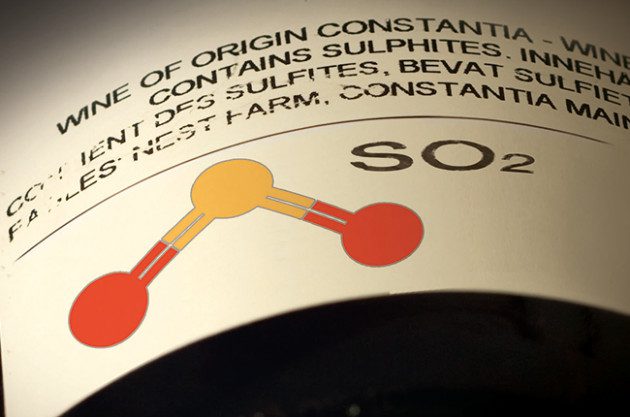
Source: Diego Di Giacomo, www.devinosyvides.com.ar
SO₂ use is regulated by the OIV, the EU, the USDA, and by wine-producing countries under OIV specifications. In the EU, sulfur dioxide used in the agri-food industry is identified on food packaging with additive codes such as E220 (sulfur dioxide) and E224 (potassium metabisulfite).
For wines where glucose + fructose < 5 g/L, the maximum permitted total SO₂ levels in the EU are:
Differences between sulphur compounds in different wines
- 150 mg/L for red wines
- 200 mg/L for white and rosé wines
How is SO₂ managed before bottling?
Before bottling, winemakers generally maintain free SO₂ between 15 and 40 mg/L to reach a molecular SO₂ level close to 0.8 mg/L, which is considered the theoretical threshold sufficient to limit microbial growth in wine.
Why talk about sulfite-free wines?
Even when staying within legal limits, excessive SO₂ use can lead to organoleptically undesirable compounds, such as hydrogen sulfide (H₂S) formed via sulfite reduction, associated with rotten egg aromas.
In terms of color, SO₂ can negatively affect anthocyanins, as it can inhibit their binding to flavonoids—resulting in color loss.
Finally, many winemakers agree that SO₂ use can “mute” or “silence” varietal aromas, producing wines that are less complex than their intrinsic potential would allow. This is why the right dosage, at the right time—considering pH, alcohol level, and operating temperature—is critical. In general, lower grape quality often requires higher SO₂ additions to limit oxidation and microbial development.
This frequently happens, for example, when working with daytime mechanical harvesting, since berries break and oxidation accelerates with heat, or when there is vineyard disease pressure (e.g., Botrytis). Another major factor is increasing consumer preference for wines perceived as more “natural,” where the addition of exogenous compounds is reduced as much as possible.
What LEV2050 proposes
At LEV2050, we offer the “Sulfite-Free Wine Study”, designed to reduce SO₂ use through the application of winery-specific tannic extracts and different native lysates with antioxidant capacity. These extracts and lysates are obtained directly from native vineyard yeasts, enabling the use of unique, natural compounds aligned with the terroir.
Sources:
Jackson, R. S. (2008). Wine science: Principles and applications (3rd ed). Elsevier Acad. Press.
Reglamento Delegado (UE) 2019/934 DE LA COMISIÓN de 12 de marzo de 2019
Ribéreau-Gayon, P., Dubourdieu, D., Donèche, B., & Lonvaud, A. (2006).Handbook of Enology Volume 1: Microbiology of Wine and Vinifications (2nd ed., Vol. 1). John Wiley & Sons, Ltd. https://doi.org/10.1002/0470010363.fmatter
Zamora Marín, Fernando (2003).Elaboración y crianza del vino tinto: aspectos científicos y prácticos. Mundi Prensa. ISBN 84-89922-88-8